
Technology overview
Multi-sensor crop health diagnostics unified by agronomic AI
CredoSense is a physiology-first crop diagnostics platform for indoor and outdoor agriculture. It integrates proprietary hardware, including a microclimate monitoring station, a rapid fungal spore counter, and a handheld leaf chamber, with satellite- and radar-based monitoring for outdoor fields and time-series monitoring for indoor benches. Rather than relying on symptoms alone, the system detects crop- and growth-stage-specific deviations, guides targeted measurements to identify the primary stress driver using a proprietary evidence-convergence method, and then uses an agronomic AI agent to deliver stress attribution and crop-specific recommendations through a single, unified application.
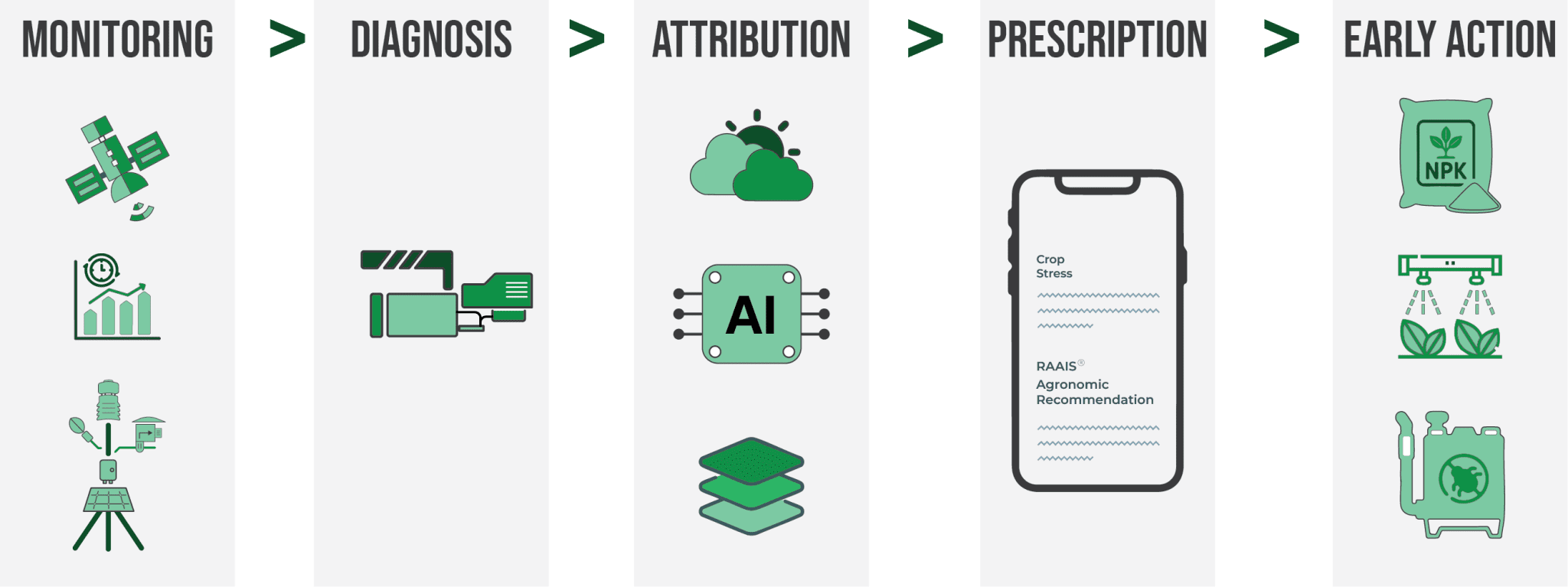
end-to-end crop health diagnostics
Our technology goes beyond monitoring: it tells you what is wrong and what to do

Satellite- and radar-based monitoring (outdoor)
CredoSense fuses satellite and radar data from multiple sources into a synthetic ten-meter resolution product that is refreshed every three days for early stress monitoring in outdoor fields. Radar maintains continuity under cloud and variable illumination, while satellite indicators capture canopy and surface dynamics linked to crop performance. Rather than relying on a single index, the system evaluates more than sixteen crop and soil health indices together and detects subtle departures from expected trajectories for the specific crop and growth stage. This screening layer helps you focus field scouting on the grids that are most likely to require confirmation measurements.
Signals we fuse
- Crop water stress
- Vigor vigilance
- Nutrient stress
- Biotic stress screening signals
- Thermal stress screening signals
- Soil moisture stress
- Topographic Wetness Index
Time-series monitoring for anomaly detection (indoor)
CredoSense uses time-series analysis to monitor indoor benches or zones and detect early deviations from expected crop- and growth-stage-specific trajectories. Rather than relying on occasional spot checks or late visual symptoms, the system evaluates changes over time relative to each bench’s baseline and to comparable benches under similar operating conditions, which improves sensitivity to subtle drift and reduces false alarms from normal development. When an anomaly is detected, the system flags the affected benches or zones and guides targeted follow-up measurements to confirm the primary stress driver before the issue becomes visible or widespread.
Signals we fuse
- Bench- or zone-level time-series trends from indoor sensing and operational data
- Environmental stability signals, including temperature, humidity, airflow, and leaf wetness
- Root-zone dynamics, including moisture, electrical conductivity, temperature, and pH
- Airborne fungal pressure and infection-favorable environmental windows
- Targeted leaf-level confirmation measurements when needed to identify the primary driver
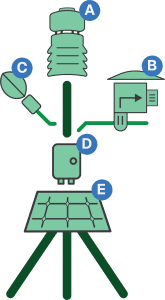
Microclimate and spore monitoring station
The CredoSense microclimate and spore monitoring station captures the environmental drivers and biological pressure signals that govern crop stress development and disease risk in both indoor and outdoor agriculture. Many systems rely on generalized conditions, but crop stress and infection risk are often controlled by local microclimate at the canopy level, including airflow, humidity, and leaf wetness. CredoSense measures these conditions using a microclimate monitoring system (A) and houses a proprietary fungal spore counter (B) within the same station to quantify airborne fungal pressure as a direct bio-threat signal. The leaf wetness sensor (C) is particularly important because it indicates host-environment suitability for infection, allowing spore pressure to be interpreted in the context of whether conditions are favorable for disease establishment and progression. The station is designed for continuous deployment and includes an onboard data logger (D) that records measurements and transmits them to the cloud through a cellular connection. It is powered by a solar panel (E) with a user-supplied battery in outdoor deployments, and it can be powered through facility power in indoor deployments. The fungal spore counter requires no consumables other than a HEPA filter and measures spore counts three times daily.
What we measure
- Incoming solar radiation
- Air temperature
- Relative humidity
- Barometric pressure
- Wind speed and wind direction
- Leaf wetness, used to determine infection-favorable environmental windows
- Precipitation (optional)
- Evapotranspiration and vapor pressure deficit
- Soil or root-zone moisture, electrical conductivity, and temperature
- Airborne fungal pressure from the integrated fungal spore counter, up to genus level

Handheld Leaf Chamber System
The CredoSense handheld leaf chamber is the confirmation step in our diagnostics workflow for both indoor benches and outdoor field grids. Early monitoring can indicate that a crop is drifting from expected performance, but it often cannot confirm the cause because many stressors produce similar visual symptoms and overlapping canopy signals. The leaf chamber closes this gap by measuring the crop’s functional response directly through rapid, repeatable leaf-level physiology and optical indicators, collected alongside local microclimate and root-zone context at the time of sampling. We typically recommend measuring approximately ten to twenty representative plants per flagged grid or bench. Measurements are taken on intact leaves while the leaf remains connected to the plant, and the root-zone probe is placed in the soil or substrate adjacent to the same plant to preserve interpretability. A full measurement set is completed in under one minute, enabling practical, high-throughput confirmation without disrupting routine scouting. The system weighs about one kilogram and the only routine consumable is desiccant. The leaf chamber connects to the CredoSense app, which provides step-by-step guidance for sampling, quality checks, and completing a measurement workflow consistently across users.
In agronomy, there is no scalable way to diagnose the primary stress driver without targeted on-site measurements. Remote sensing and fixed sensors are excellent for screening and prioritization, but they do not replace direct plant-response confirmation when a decision must be made. CredoSense makes this practical by focusing measurements only on the highest-priority grids or benches, turning research-grade plant science into a repeatable field workflow.
Inputs that power attribution
- Photosynthesis
- Stomatal conductance
- Plant water use efficiency
- Leaf temperature and leaf temperature anomaly
- Leaf moisture content
- Photochemical Reflectance Index
- Light-adapted Photosystem II
- Leaf chlorophyll content
- Leaf flavonoids, carotenoid, and anthocyanin contents
- Leaf nitrogen, phosphorus, and potassium contents
- Visible symptom detection using machine learning
- Canopy-level air temperature, relative humidity, and barometric pressure at the point of sampling
- Soil or root-zone moisture, electrical conductivity, temperature, pH at the point of sampling
Stress Attribution and Prescription Engine (RAAIS)
RAAIS is the CredoSense region-aware agronomic intelligence engine that converts multi-source measurements into a decision-grade conclusion about the primary stress driver and the next best agronomic action. It is grounded in plant ecophysiology and epidemiology: a correct attribution should be consistent with the crop’s physiological response, the root-zone and atmospheric drivers that regulate water and carbon exchange, and the biological pressure and environmental windows that enable infection and disease progression. RAAIS therefore fuses convergent evidence across crop response, soil and root-zone state, microclimate exposure, leaf optics and chemistry, and biological threat signals, and evaluates these signals in the context of crop type, growth stage, and recent management history.
Instead of treating anomalies as a single label, RAAIS weighs alternative stress classes and identifies the most supported constraint, explicitly distinguishing between abiotic drivers such as water limitation, thermal or radiation load, and nutrient imbalance, and biotic pressure when pathogen signals and infection-favorable conditions align with crop response patterns that cannot be explained by environment alone. When evidence is incomplete or mixed, RAAIS remains intentionally conservative: it narrows the plausible causes, highlights what is most likely, and recommends the next best measurement or field check to resolve uncertainty before costly interventions are applied.
Once attribution is established, RAAIS generates prescription-ready recommendations that are crop-, stage-, and context-specific. Recommendations translate the identified driver into practical actions such as irrigation and fertigation adjustments, nutrient corrections, and crop protection decisions, with timing guided by microclimate conditions and forecasted risk windows. RAAIS is region-aware by design: it incorporates local agronomic best practices and constraints so recommendations remain practical and appropriate for the operating region. It also supports continuous improvement through structured user feedback and outcome tracking, enabling controlled refinement of recommendation quality over time while maintaining agronomic guardrails.
The RAAIS evidence stack
- Crop response evidence from targeted leaf-level physiology and optical indicators
- Soil and root-zone state, including moisture, electrical conductivity, temperature, and pH
- Microclimate exposure, including temperature, humidity, airflow or wind, radiation, and leaf wetness
- Airborne fungal pressure signals from the integrated fungal spore counter
- Satellite and radar screening signals for outdoor grids and time-series anomaly signals for indoor benches or zones
- Weather forecasts and extreme-weather alerts to interpret exposure history and near-term risk windows
- Farm or facility context, including crop and variety, planting or transplant dates, growth stage, and recent management actions
- Optional geospatial layers for outdoor fields, such as soil texture, elevation, yield maps, and nutrient maps when available.